

Hemory Wants Your AI to Remember What You Heard
A small team at ONES spent nine months building an always-on listening app that turns your everyday conversations into memory your AI agents can actually use.
SecondWing Editorial
4 min read
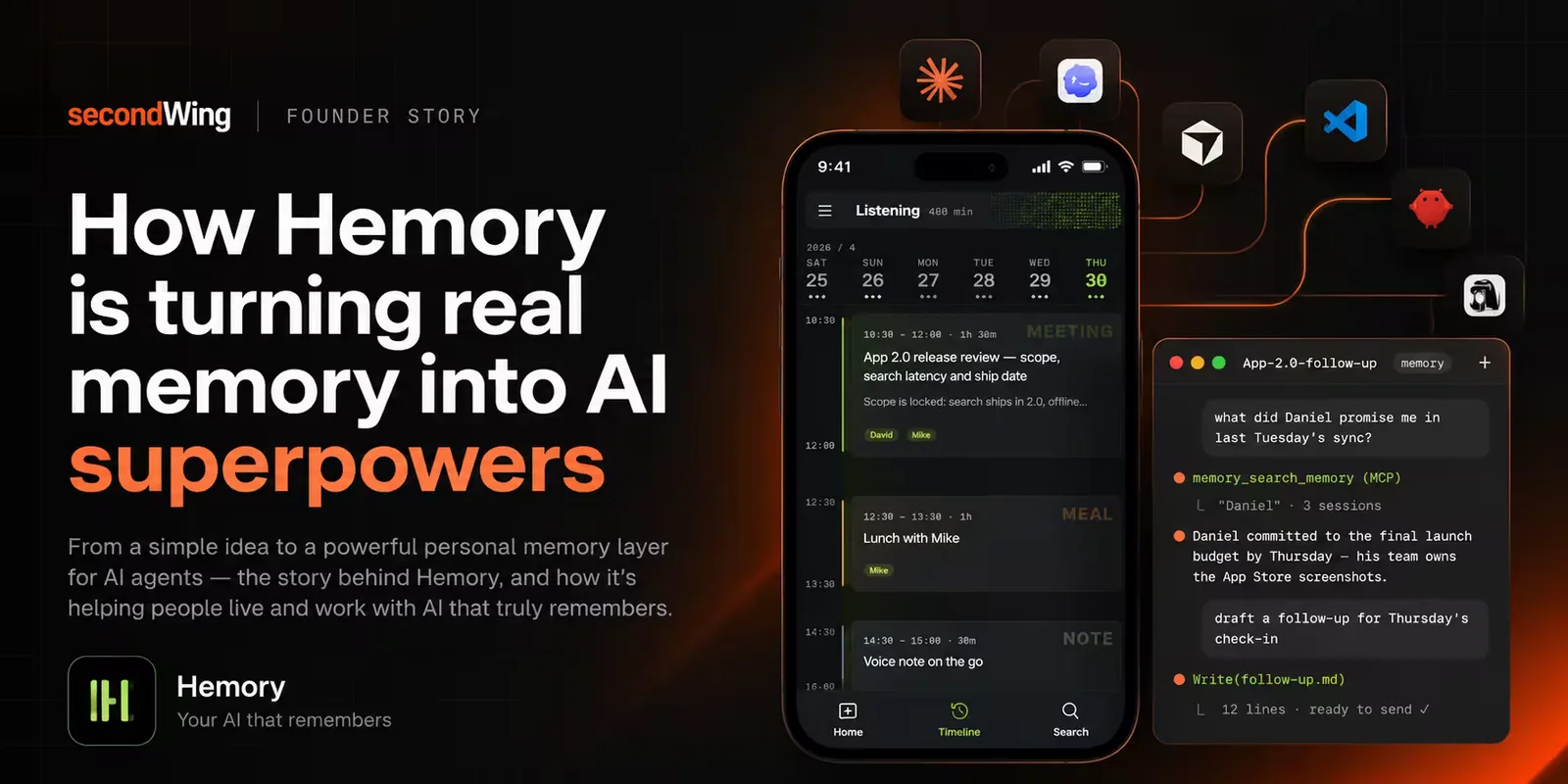
A small team at ONES spent nine months on a simple question: what if your AI agent knew what was actually said in your meetings, calls, and hallway chats?
Most AI tools know a lot about the world and almost nothing about your day. They can draft a report, but they don't know what your manager promised on Tuesday or what a customer complained about last week. That context lives in conversations, and conversations mostly disappear.
Hemory is built to catch them.
A problem that started with a forgotten record button
The idea came from founder Yingqi Wang's own calendar. In his launch post, he wrote that meetings took up half to two-thirds of his workday. He kept forgetting to hit record. When he did remember, he sometimes left it running, and several conversations ended up merged into one long transcript. Even with AI summaries, connecting what was discussed across different days was still manual work.
The fix wasn't a better meeting recorder. It was to stop treating conversations as separate recordings at all.
Hear + Memory
The name is a blend of "hear" and "memory," and the team is clear that this isn't meeting transcription. Hemory listens in the background on a phone or Apple Watch you already own. As the day goes on, it splits what it hears into separate moments with speaker labels, so a morning review, a lunch conversation and a voice note on the walk back each become their own entry in a timeline.
You choose how "always-on" it is. Manual mode turns listening on only when you want it. Schedule mode runs automatically within set hours, like weekdays from 9 to 6. On the top plan, Hemory can listen for up to 24 hours a day.
The real bet: memory for your agents, not another chat app
Many products in this space would have built their own AI chat on top of the transcripts. Hemory went a different way. It connects to the AI tools people already use through MCP (Model Context Protocol), an open standard that lets AI agents call outside tools. Setup is a single command, and the agent gets a memory search tool.
The website lists support for Claude Code, Codex, Gemini, Cursor, VS Code, OpenClaw and Hermes, plus other standard MCP clients. Once connected, you can ask your agent things like which commitments a colleague made in last week's sync, then have it draft the follow-up. Hemory's own examples go further: a monthly report deck built from a month of work conversations, a short nightly journal of your day, or a product requirements document assembled from customer interviews and internal brainstorms.
Privacy as a design decision
A product that listens all day has to answer the privacy question up front, and Hemory makes it a headline feature. According to the website, audio is never stored in the cloud. It's processed as a stream and deleted as soon as processing finishes. Raw audio stays only on the device that recorded it and isn't synced to your other devices. A self-hosted option, for running Hemory entirely on your own infrastructure, is listed as coming soon.
One thing Hemory can't solve for you is the people on the other side of the conversation. If you plan to listen all day, it's worth letting colleagues know and checking the recording rules where you live and work.
Pricing built around speech, not hours
All-day listening sounds expensive, so Hemory prices it differently. It uses voice activity detection, which means only moments when someone is actually speaking count toward your quota. Silence, pauses and background noise are free.
The plans:
- Free Trial: $0, 10 hours of listening, one-time
- Starter: $10/month, 20 hours
- Pro: $20/month, 60 hours
- Max: $50/month, unlimited listening with a 24-hours-a-day fair-use cap
Who's behind it
Hemory is made by a small team inside ONES.com. The About page lists six team members. Wang is CEO of both ONES.com and Hemory.com, is based in Sunnyvale, California, and describes himself as building everything with AI coding agents.
What's next
Hemory is available today on iOS, Apple Watch and Android. macOS, Windows, Linux, web and self-hosted versions are listed as coming soon.
Who it's for
Hemory makes the most sense for people whose work happens in conversation, like founders, managers, consultants, researchers and anyone running customer interviews, and who already use an AI agent for writing or planning. If your agent is the place where work gets done, Hemory is a way to give it the one thing it's missing: what actually happened.